If your gross side hustle earnings exceed £1,000 in a tax year, you must register for Self Assessment with HMRC by 5 October following the end of that tax year — even if your actual profit is lower.
Key Takeaways
- Selling personal items is not taxed, but actively trading for a profit requires you to follow HMRC side hustle tax rules.
- The trading allowance allows you to earn up to £1,000 tax-free each tax year before you must declare your additional income.
- You must register for Self Assessment by 5 October if your total gross side hustle earnings exceed the 1,000 pound threshold.
- The absolute deadline to file your tax return and pay any tax due is 31 January to avoid unexpected financial penalties.
- You must keep full and accurate records of all sales and expenses to prove your tax compliance to HMRC.
Table of contents
1. Check if you need to pay tax on your side hustle
To know if you owe tax, you must first determine the difference between selling unwanted personal belongings and taxable trading.
The distinction ensures you do not pay tax when simply clearing out your attic, and prevents an unexpected tax bill when you actively make a profit.
Types of the most common side hustles people have in the UK:
- E-commerce & reselling (Vinted, Etsy, eBay, FB Marketplace, Amazon)
- Gig economy & services (Ubor, Bolt, Just Eats, Deliveroo, pet care, tasking & manual labour)
- Digital & freelance work (copywriting, graphic design, web development, social media management, virtual assistant)
- Low-effort/task-based (paid online survey, mystery shopping, user testing, data entry & transcription)
- Property & space (Airbnb hosting, storage, parking rental)
The crucial factor is your intent. If you buy goods specifically to sell them for a profit, or if you regularly offer a service to make money, you are officially trading.
However, if you just sell old clothes or occasional crafts online without a profit motive, you generally do not need to report this income to HMRC. If your situation feels borderline or you are unsure if you cross the line into trading, you are urged to check the GOV.UK guidelines to confirm your status.
2. How the trading allowance covers side hustle income
The trading allowance provides a firm tax-free limit for your extra income, directly dictating whether you have a responsibility to tell HMRC about your earnings.
This allowance lets anyone earning extra income make up to £1,000 completely tax-free each tax year. This applies to your total income before deducting any business expenses – you must count every penny of revenue you receive from your customers.
Here is how your total revenue changes your reporting responsibilities:
- Earning under £1,000 – You do not register, you do not tell HMRC, and you do not pay any tax on it.
- Earning over £1,000 – The tax rules change. You must declare your side hustle income even if your actual profit is lower.
If your total income stays below this limit, you are automatically covered and need to do nothing further.
Once your sales cross that £1,000 threshold, you trigger the requirement to report, regardless of whether you are selling crafts or providing a service.
3. When to register for Self Assessment?
You must follow a strict timeline for declaring your additional income to avoid penalties and keep your side hustle compliant.
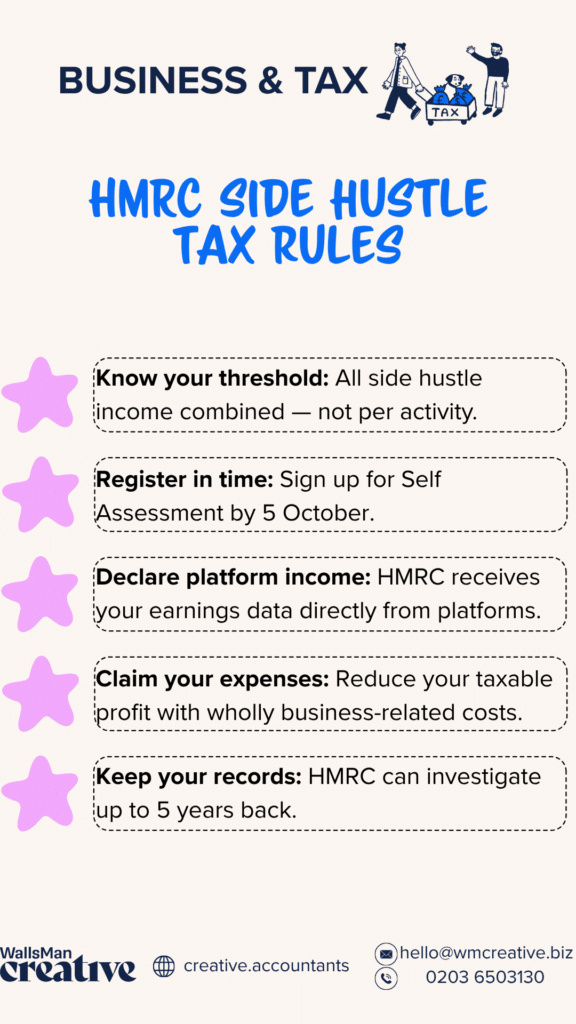
The tax year runs from 6 April to 5 April the following year. If your gross side hustle earnings crossed the 1,000 pound threshold, you need to register for Self Assessment.
You must register with HMRC by 5 October following the end of the tax year in which you earned the extra income. For example, if you earned your additional income between 6 April 2025 and 5 April 2026, your deadline to register is 5 October 2026. Setting up as a sole trader early ensures you have the right accounts active to file a tax return online when the time comes.
4. How to file tax return and pay what you owe?
Submitting your Self Assessment tax return means meeting strict filing deadlines and understanding how your side hustle impacts your main job taxes.
After you register, HMRC will send you a Unique Taxpayer Reference (UTR) number, which gives you the information you need to complete your Self Assessment return.
When filing, you must calculate the tax you pay based on several factors:
- Personal allowance: Your standard tax-free threshold that applies across all your employment.
- Tax bands: The rate applied to your combined total income, including your main job and your taxable side hustle profits.
- National Insurance: The extra contributions you may owe depending on your total self-employed earnings.
- Tax already paid: The section where you show any tax already deducted through your standard PAYE employment.
The absolute deadline to file a tax return online and pay any tax due is 31 January. Missing this date results in immediate financial penalties, even if you do not actually owe any tax on your side hustle.
5. Your responsibility to keep full and accurate records
Ongoing financial documentation is a mandatory requirement for your side hustle.
Keeping accurate records of all sales and expenses protects you if HMRC ever questions your tax return and ensures you do not overpay.
You have a legal responsibility to keep full and accurate records of all sales and the income you make, as well as the costs you incur. Whether you manage a simple spreadsheet yourself or hire an accountant or bookkeeper, tracking everything from day one is vital.
Documenting your finances correctly allows you to achieve the following:
- Monitor your extra income to know exactly when you cross the trading allowance.
- Deduct valid business expenses to reduce your overall taxable income.
- Provide clear proof of your operations if HMRC requests it.
Juggling a side income on top of your main job?
It can get messy fast.
At WallsMan Creative, we help creative businesses across the UK make sense of it all – keeping your side projects above board and your finances working harder for you, so you can get back to doing what you love.