Distributable reserves are what legally determine if a limited company can pay a dividend.
A company can report a healthy net profit for the year and still be unable to pay a dividend, because distributable reserves are the cumulative profits built up since the company began, after deducting prior-year losses and other restrictions.
Key Takeaways
- Distributable reserves, not net profit, determine if a company can legally pay a dividend.
- Net profit measures a single year’s performance on the Profit & Loss account; distributable reserves are cumulative profits shown on the Balance Sheet.
- A company can be profitable this year and still have insufficient distributable reserves if it made losses in earlier years.
- Director’s loan accounts, unpaid tax, and outstanding debts can all reduce distributable reserves even when net profit looks healthy.
- Always check the Balance Sheet, not just this year’s Profit & Loss account, before voting to pay a dividend.
Table of contents
1. What are distributable reserves?
In simple terms:
- Distributable reserves = profits your company can legally pay as dividends.
- Not all profits are automatically distributable.
These are all accountancy jargons, so let’s take a look at an example on how this works in action!
Think of distributable reserves as your company’s “savings pot” of available profits. If your business has made profits but hasn’t used them up (e.g., paying dividends or covering past losses), they sit in this pot as distributable reserves.
But there’s the catch: not all profits count as distributable reserves.
Profits can be tied up or restricted (revaluation reserves or certain accounting adjustments). That means that you can’t use them for dividends – even if they show up as profits in your accounts.
2. Difference between distributable reserves vs net profit
Your net profit is what your business actually makes after paying all its bills and costs. Basically, you earn money from sales or services (this is your income), you subtract your expenses (like materials, rent, wages, taxes etc.), and the money left over is your net profit.
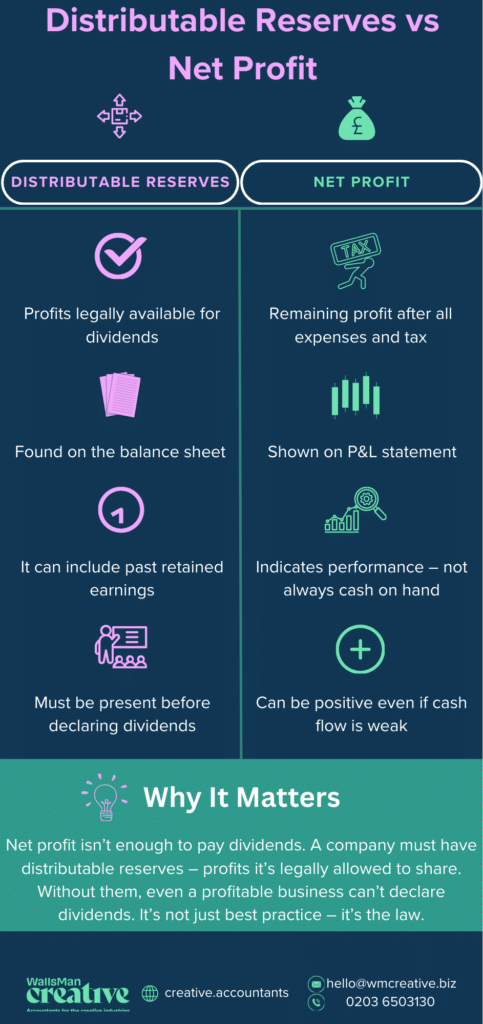
But what is the difference between net profit vs distributable reserves?
| Net Profit | Distributable Reserves | |
|---|---|---|
| What it is | What the business earned after all costs this year | Cumulative profits legally available to pay as dividends |
| Statement | Profit & Loss account | Balance Sheet |
| Time period | Single financial year | Entire company lifetime, all years combined |
| Determines dividends? | No: a good year alone isn’t enough | Yes: this is the figure that governs what you can pay |
| Reduced by | This year’s expenses only | Prior-year losses, outstanding loans, excessive director’s loan account, unpaid tax |
| Restrictions | N/A | Some profits are tied up (e.g. revaluation reserves) and can’t be distributed even if they show as profit |
Your net profit is shown in your Profit & Loss account, which only looks at a single year. But distributable reserves appear on your Balance Sheet, which shows your company’s overall financial picture, and it covers every year since you started the business.
And to pay dividends, you must have enough money built up from all previous years combined, not just from a single good year.
3. Why a healthy net profit doesn’t always mean you can pay dividends
See below some of the reasons why you could have a healthy net profit but insufficient distributable reserves to take a dividend:
- Losses have been made in earlier years
- Loans have been received and are spent, but the debt remains outstanding
- Director’s loan account is excessive
- Unpaid tax bills
So, when considering whether you can take dividends, do not just look at net profit in isolation.
It will be the distributable reserves held in the Balance Sheet which determine dividends payable. It is the results of a company over its lifetime that make up distributable reserves, not just performance in one financial year.
4. Getting your dividend timing right with WallsMan Creative
The difference between net profit and distributable reserves is actually quite straightforward.
Net profit is just what you earned this year. Distributable reserves include your company’s entire financial history – that’s what actually determines if you can take money out as dividends.
Accounting terms shouldn’t make your head spin, especially when you’re busy creating. You need someone who understands both numbers AND the creative world – someone who speaks your language.
Our team specialises in helping people just like you – artists, designers, filmmakers, musicians and content creators. We’ll help you see your financial picture clearly, avoid mistakes, and maximise what you can take home.
Ready to focus on creating while we handle the numbers? Let’s talk!