National Insurance is one of those taxes that most people pay automatically: it’s a tax on earnings to fund benefits and State Pension.
Try our National Insurance calculator and see your breakdown.
Key Takeaways
- National Insurance is a tax on your earnings, not a savings pot: the money funds the State Pension, statutory sick pay, and other benefits on a pay-as-you-go basis.
- You start paying NI at 16 if you earn above the threshold, and you stop at State Pension age, even if you’re still working.
- The class of NI you pay depends on your employment status – employees pay Class 1 at 8%, while self-employed people pay Class 4 at 6% on profits between £12,570 and £50,270.
- Gaps in your NI record can reduce your State Pension entitlement – you need 35 qualifying years for the full State Pension.
- Your National Insurance number is the unique reference that ties your contributions to your record: you’ll need it to work, file tax returns, and claim benefits.
Table of contents
1. What is National Insurance?
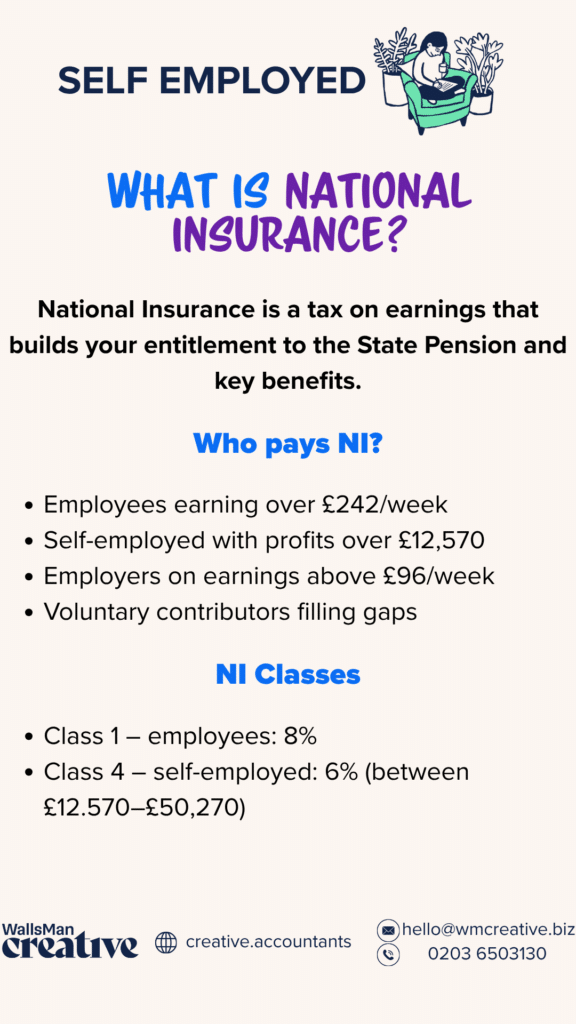
National Insurance (NI) is a compulsory contribution paid by workers, employers, and the self-employed in the UK.
Despite the name, it isn’t insurance in the traditional sense: you’re not paying into a personal pot that pays out when something goes wrong.
It’s a tax on earnings that feeds into government funds, primarily the National Insurance Fund, which is then used to pay for the State Pension and a range of contributory benefits including Statutory Sick Pay, Maternity Allowance, and Jobseeker’s Allowance.
One useful way to think about it: your NI contributions build a record that determines what you’re entitled to later. Pay enough over enough years, and you qualify for the full State Pension and certain other benefits. Pay too little – or have gaps – and your entitlement shrinks.
2. Who pays National Insurance?
Most people working in the UK pay NI in some form. The rules apply from age 16 until you reach State Pension age:
- Employees earning more than £242 per week (£1,048 per month) from a single job
- Self-employed individuals with trading profits above £12,570 per year
- Employers, on behalf of their employees, on earnings above £96 per week (£5,000 per year)
- Voluntary contributors who want to fill gaps in their record
If you earn between £129 and £242 per week as an employee, you don’t pay NI – but you’re treated as if you have, which protects your contribution record without any money leaving your pocket.
For the self-employed, a similar credit applies to profits between £7,105 and £12,570.
Gaps in your record and voluntary contributions
NI gaps are more common than people realise.
You can have gaps in your contributions from periods of self-employment with low profits, career breaks, time working abroad, or simply not earning enough to trigger mandatory contributions.
Each gap year you have reduces your eventual State Pension entitlement, and if you have fewer than 10 qualifying years, you get nothing at all.
You can check your NI record online through your HMRC personal tax account.
To tackle this challenge, you can make voluntary national insurance contributions yourself.
3. National insurance classes: quick reference
NI is split into classes, and the class you pay determines what counts towards your entitlement record.
The main classes in the 2026/27 tax year:
| Class | Who pays | Threshold | Rate |
|---|---|---|---|
| Class 1 (employee) | Employees | £242–£967 per week | 8% between the primary threshold and upper earnings limit; 2% above |
| Class 1 (employer) | Employers | £96 per week / £5,000 per year | 15% above the secondary threshold |
| Class 2 | Self-employed | Small profits threshold is £7,105 | No separate payment for many people; it counts as paid for entitlement purposes |
| Class 3 | Voluntary contributors | N/A | £18.40 per week, not £3.50 |
| Class 4 | Self-employed | Profits over £12,570 | 6% between £12,570 and £50,270; 2% above |
4. What your National Insurance contributions pay for
Your NI contributions don’t go into a ring-fenced account with your name on it. They flow into the National Insurance Fund and are spent in the same year they’re collected. That said, your contributions record does matter – it’s what determines whether you qualify for the following:
- State Pension – you need 35 qualifying years for the full new State Pension (currently £221.20 per week); you need at least 10 years to receive anything at all
- Statutory Sick Pay – currently £116.75 per week, paid by your employer when you’re off sick for more than four days
- Maternity Allowance – relevant for self-employed women who don’t qualify for Statutory Maternity Pay
- Jobseeker’s Allowance (contribution-based) – available if you’ve paid enough NI and become unemployed
- Bereavement Support Payment – a lump sum plus monthly payments if your spouse or civil partner dies
A portion of NI receipts is also allocated to the NHS before the rest moves to the National Insurance Fund, which is why NI and healthcare funding are often mentioned together.
5. Where to find your National Insurance number?
Every person living and working in the UK is issued a National Insurance number (NI number or NI no).
It’s a unique personal reference in the format: two letters, six digits, one letter.
For example: AB123456C.
Your NI number is what links all your contributions to your record, so it needs to appear on your payslips, tax returns, and correspondence with HMRC.
You’ll usually receive your NI number automatically just before your 16th birthday if you’re a UK resident. If you’ve come to the UK from overseas, you’ll need to apply before you can work and pay contributions.
If you’ve lost your NI number, you can find it on:
- Previous payslips or P60s
- Letters from HMRC
- Your personal tax account at hmrc.gov.uk
You can’t legally be required to give your NI number to an employer before you start work, but you will need to provide it so your tax code can be set up correctly.
6. National Insurance for creatives: where it gets complicated
For most employees, NI is invisible: it’s deducted before you see your pay, and that’s the end of it. (Although we’re sure you can feel it on your paycheck.)
But if you’re self-employed, and your creative business or creative agency juggles multiple income streams, NI is more of a planning consideration, and not a passive deduction.
WallsMan Creative works exclusively with people in the creative sector – from freelance designers and photographers to production companies and agency directors. If you want to make sure your NI position is handled correctly, and that you’re not leaving State Pension entitlement on the table unnecessarily, our team is here to help.