Selling to EU from UK has changed quite a bit after Brexit.
Key Takeaways
- Selling directly to EU consumers from the UK is treated as an export, meaning UK VAT is not charged at the point of sale in most cases.
- EU customers may have to pay import VAT and customs duties when goods enter their country, which can affect conversion rates and customer satisfaction.
- For goods valued at €150 or less, sellers can use the Import One Stop Shop (IOSS) to charge EU VAT at checkout and avoid delivery delays.
- You need a UK EORI number to export goods and may also need an EU EORI number depending on your shipping and fulfilment setup.
- Holding stock or using fulfilment centres in the EU usually creates a VAT registration requirement in that country.
UK businesses are no longer part of the EU’s single market and customs union. New rules now apply when trading across the border. It doesn’t matter if you sell physical goods, digital products or services, you must adapt to a complex trading landscape.
Table of contents
1. UK is no longer part of the EU single market
So, ever since the UK left the EU, the way businesses sell goods and services across borders has become more complicated.
The UK-EU Trade and Cooperation Agreement removed tariffs and quotes for most goods, but it didn’t eliminate the extra admin and regulatory hurdles. UK sellers now face custom checks, VAT changes, and product compliance rules that didn’t apply before.
What does this mean for ecommerce businesses:
- longer delivery times
- higher costs
- more paperwork.
Even platforms like Shopify and marketplaces like Amazon have new guidance for cross-border sales, and also online sellers need to factor in everything from duty charges to country-specific VAT rules.
Don’t get scared: you can still reach EU customers, but the ease of selling something into the bloc has dropped. A few years have already passed after Brexit, so it’s final time to learn about these things.
5 reasons why it’s still worth it to sell goods services to EU consumers
After examining the extra regulatory hurdles, you can ask: why is is still worth it to sell to the EU from the UK?
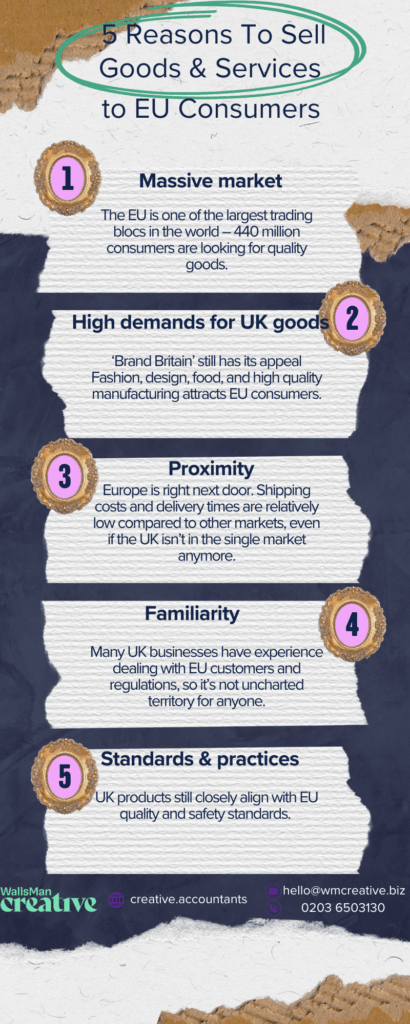
Some solid reasons:
- Massive market: The EU is one of the largest trading blocs in the world – 440 million consumers are looking for quality goods.
- High demands for UK Goods: ‘Brand Britain’ still has its appeal Fashion, design, food, and high quality manufacturing attracts EU consumers.
- Proximity: Europe is right next door. Shipping costs and delivery times are relatively low compared to other markets, even if the UK isn’t in the single market anymore.
- Familiarity: Brexit happened, but it didn’t delete the previous relationship completely. Many UK businesses have experience dealing with EU customers and regulations, so it’s not uncharted territory for anyone.
- Shared standards & practices: UK products still closely align with EU quality and safety standards.
2. Do you need to register for VAT in the EU?
UK businesses selling goods to EU customers may need to register for VAT in individual EU countries. It all depends on how you operate your business.
For example, if you store goods within an EU member state or your total B2C sales into the EU exceed the EU-wide distance selling threshold of £8,818 per year, you’ll need to register for VAT in at least one member state.
There’s a solution called Import One Stop Shop (IOSS). IOSS is an EU scheme that simplifies VAT reporting for UK businesses selling low-value goods directly to EU consumers. If the value of each order is £130 or less, you can register for IOSS to collect and pay VAT at the point of sale.
Goods vs. digital services
Selling digital services – like online courses, downloadable content, or software – to EU customers means charging VAT based on where your customer lives. The One Stop Shop (OSS) allows you to register in one EU country and report VAT on all EU digital sales through a single quarterly return.
3. Shipping and fulfilment when selling from the UK to the EU
Brexit changed how goods physically move from the UK to the EU. Even if your VAT setup is correct, poor shipping and fulfilment choices can still lead to delays, unhappy customers, and abandoned orders.
Here’s what you need to get right:
Customs clearance is now part of every EU delivery
Every shipment from the UK to the EU must pass through customs. This means your courier will need accurate paperwork, including a commercial invoice, correct commodity (HS) codes, and the right EORI number. Errors often result in parcels being held, returned, or charged extra fees.
You must have the right EORI number in place
A UK EORI number is mandatory to export goods from the UK. If you store goods in the EU or act as the importer of record, you may also need an EU EORI number. Without this, couriers may refuse to ship or customs may block the delivery.
Decide who pays import VAT and duties upfront
If import VAT and duties are charged on delivery, your customer will usually be contacted by the courier to pay before receiving their goods. This is a common cause of refused deliveries and refunds. Using Delivered Duty Paid (DDP) shipping or IOSS for low-value goods can help avoid this friction.
IOSS can simplify shipping for low-value goods
For consignments valued at €150 or less, the Import One Stop Shop (IOSS) allows you to charge EU VAT at checkout. This removes import VAT at the border, speeds up delivery, and creates a better customer experience.
EU fulfilment centres can reduce delays but increase compliance
Storing stock in the EU can eliminate customs delays and improve delivery times. However, it usually triggers VAT registration requirements in the country where goods are stored. This trade-off needs to be weighed carefully before switching to EU fulfilment.
Choose couriers experienced in EU customs
Not all couriers handle EU customs equally well. Working with carriers that specialise in UK-to-EU trade reduces the risk of documentation errors, unexpected charges, and delivery failures.
Clear communication protects your brand
Make it clear at checkout whether prices include VAT and duties, how long delivery will take, and whether customers might be charged on arrival. Transparency reduces complaints, chargebacks, and negative reviews.
4. Customs declaration and duties for goods sold to the EU
Selling goods from the UK to the EU now involves customs.
What does this mean?
Every shipment needs a customs declaration. You must include details like the value of the goods, commodity codes, and where the goods were made.
Now, there is a key threshold to keep in mind: £135.
- If the value of the goods is below £135, import VAT is usually paid at the point of sale.
- If it’s above £135, the buyer may have to pay VAT and customs duties when the parcel arrives.
The Low-Value Consignment Relief (LCVR) no longer applies. All goods – regardless of their value – are now subject to VAT in the destination country.
You, as the UK seller, have to be clear about pricing, delivery terms, and who is responsible for tax and duty.
5. 7 key considerations when selling to the EU from the UK
Selling to the EU from the UK is still very possible, don’t let anyone tell you otherwise. But it takes more planning than it used to.
Let’s revisit the main points to keep in mind if you’re trading goods or services cross-border:
- You may need to register for VAT in the EU, especially if your annual sales exceed £8,818
- Use the IOSS scheme if you’re sending low-value goods under £135 to EU customers
- Customs declarations are required for every shipment leaving the UK
- Make sure your pricing and delivery terms are clear to avoid surprises for buyers
- Selling digital services? VAT is charged based on the customer’s location
- Delivery delays are more common, so plan for extra time in fulfilment
- Using an EU fulfilment partner can help speed things up and reduce friction
We help UK businesses manage EU sales, VAT compliance, and customs paperwork with clarity. If you need support with cross-border setup, advice on tax registration, or help sorting out UK-EU ecommerce rules this is where you’ll reach us: